Monday, October 30, 2006

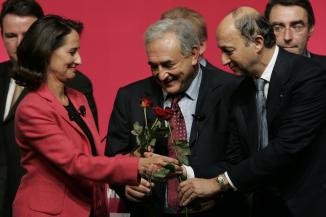
The war of the roses / La guerre des roses

France is in the middle of the most fascinating political period in years. It is due to many factors: first, who will succede to Jacques Chirac, who has occupied the seraglio of power for more than 30 years? Then, the earthquake of 2002 and the presence at the second round of the neo-nazi Jean-Marie Le Pen beg the question: will he still be around? Finally, will a woman be President, whether on the left or on the right: Segolene Royal for the Socialist Party, (whose emblem is the rose) or perhaps Michele Alliot-Marie (who hasn't discarded the possibility of being a candidate for the UMP, Chirac's party)? The debate within the Socialist Party between the three hopefuls has turned into a struggle, and the image of the longago war of the roses (three in this case) between the rival houses of York and Lancaster can reemerge now. The one organised at the Zenith (a Parisian concert-hall) between Dominique Strauss-Kahn (DSK), Laurent Fabius and Mme Royal was marred by boos, especially towards the end of Mme Royal's 38-minute long speech. All other parties should take a leaf out of the book of the PS in their bid to rejuvenate democracy (etymologically, the "governing by the people"): however, PS partisans should not cut off their noses to spite their faces when jeering. What could happen is the entire collapse of the Socialist edifice: the supporters of the Houses of York and Lancaster caused the destruction of the original branch, the Plantagenets, making way for the Tudor era.

La France est au centre d'une periode des plus fascinante politiquement depuis des annees. Cela releve de plusieurs facteurs: tout d'abord, qui succedera au President actuel, occupant du serail du pouvoir depuis 30 ans, Jacques Chirac? Puis, le cataclysme de 2002 avec la presence au second tour du neo-nazi Jean-Marie Le Pen pose la question la question de son retour eventuel. Enfin, le prochain President sera-t-il une femme? Avec pour le PS (dont l'embleme est la rose), Segolene Royal, et pour l'UMP, Michele Alliot-Marie, qui dit n'ecarter aucune possibilite. Le debat au sein du PS entre les trois pretendants s'est change en lutte, et l'image de la lointaine guerre des deux roses (ici trois) entre les deux maisons rivales de Lancaster et de York vient reemerger. Le debat recent du Zenith entre Dominique Strauss-Kahn, Laurent Fanius et Mme Royal a ete gache par les sifflets de la foule vers la fin du discours de 38 minutes de celle-ci. Tous les autres partis devraient emboiter le pas au PS dans sa tentative de revivifier la democracie (etymologiquement le "gouvernment par le peuple"). Cependant, les partisans du PS ne devraient pas scier la branche sur laquelle ils sont assis en sifflant. Ce qui pourrait arriver serait l'effondrement de l'edifice socialiste: les combattants des maisons de York et de Lancaster causerent la ruine de la maison-mere des Plantagenets, laissant la place aux Tudors.
Posted by Picasa

Thursday, August 10, 2006

Harry Potter: children's literature? / littérature pour enfants?

JK Rowling's best-selling Harry Potter books are mostly aimed at kids, aged 9-11, according to Bloomsbury, the publisher. That can be understood in the first three instalments, which contain straightforward plots, center around the Hogwarts School of Wizardry where Harry goes, and don't exceed 300 pages. Everything changes in "Harry Potter and the Goblet of Fire", a 630 pages-long volume. The sheer size can act as a deterrent, but more importantly the scope is different: two foreign Schools are added, a multitude of characters is substituted to a usually short cast. Of course, although the seven volumes (Harry's novel of growth), represent a huge read, both qualitatively and quantitatively, any devoted child will go through them. But it is on the level of meaning and significance that JK Rowling raises the standards, in terms of literariness. Meaning is layered, and this is why theses novels are very much enjoyable by grown-ups. Onomastics (languages such as Latin, Greek and French being very much in use) is paramount to Rowling's strategy, the construction of the narrative is a juxtaposition of subplots that assemble like a jigsaw puzzle and there is something Dickensian (i-e absurd and comical) about certain elements: the Ludicrous Patents Office in the Ministry of Magic in particular is reminiscent of the Circumlocution Office in Little Dorrit. Posted by Picasa

Wednesday, July 26, 2006

Dissonances in Lebanon / Dissonances au Liban

This food-for-thought cartoon from the British newspaper The Daily Telegraph shows the current American Secretary of State Condoleeza Rice, a renowned pianist, playing a difficult score (amongs many others...) : that of the "Lebanon Peace Overture". The US position in that country is difficult to hold: one the one hand, they provide Israel with sophisticated weapons, on the other hand they supply food to endangered civilians. It is a catch-22 situation: Israel must show it can win against Hezbollah to appear as a deterring power in the region; and Hezbollah wants to resist as long as possible, win and continue to attack Israeli areas such as Haifa. It does not have the military power of the Hebrew state of course, and casualties in Lebanon are in their hundreds while in Israel they are in their dozens. What is to deplore in Israel's tactics is the massacre of innocent civilians (and the latest killing of four UN envoys in South Beirut) and above all the tearing apart of the Lebanese society, which had managed to extirpate itself from many years of instability and civil war. Three questions: will the American Secretary play the Lebanese score "con dolceza" (to use her Christian name)? Will there be a ceasefire soon? Last but not least, will there be harmony in Lebanon, and around it in the Middle East?
Posted by Picasa

Tuesday, July 25, 2006

Ithaque and Heimat / Ithaque et le Heimat

Going to the Greek island of Ithaca, in the Ionan sea, is a strangely familiar experience, even if one sets foot on its soil for the first time. Is it the memory of Ulysses' (or Odysseus') travels around the Mediterranean, before he returned home? Or the imposing yet oddly welcoming scenery? One feels at home, making Ithaca the epitome of the German concept of Heimat. Once the traveller leaves the island, he realises he can taste a sample of the nostalgia that Ulysses felt when away from his home. Anyone who has experienced exile keeps an Ithaca in their hearts. As the 16th century poet du Bellay put it: "Happy the man who, like Ulysses, has made a fine voyage, or has won the Golden Fleece, and then returns, experienced and knowledgeable, to spend the rest of his life among his family."

Aller dans l'ile grecque d'Ithaque dans la mer ionienne est une experience etrangement familiere, meme si l'on y pose le pied pour la premiere fois. Est-ce le souvenir des voyages d'Ulysse autour de la Mediterranee avant qu'il rentre chez lui? Ou les paysages, imposants mais singulierement accueillants? L'on se sent chez soi, ce qui fait d'Ithaque l'epitome du concept allemand de Heimat. Une fois que le voyageur quitte l'ile, il se rend compte qu'il goute un peu de la nostalgie que ressentait Ulysse, loin de chez lui. Quiconque a fait l'experience de l'exil garde une Ithaque en son coeur. Comme le poete du Bellay le disait:

"Heureux qui comme Ulysse a fait un beau voyage,
Ou comme cestuy-la qui conquit la toison,
Et puis est retourne, plein d'usage et raison,
Vivre entre ses parents le reste de son age!"
Posted by Picasa

Friday, July 7, 2006

France behind "Les Bleus" / La France derrière "Les Bleus"

This blog will be short and timely: it is written on the eve of the World Cup final, between Italy and France, between the art sisters. A match between two hues of blue: "Les Bleus" against the "Squadra Azzura". Paris vs. Rome. Gauls vs. Romans. Vercingetorix vs. Caesar. A tale of two cities, or more accurately, two countries. In both cases, a patriotic sentiment has emerged as the teams progressed in the competition, temporarily obliterating current feelings of economic, political or even footballistic (in Italy's case) crisis. Unity and identity are forged again behind a multicutural team, beyond all political lines. Long may it last.


Ce blog sera court et opportun: il est écrit la veille de la finale de la Coupe du Monde de football, qui opposera la France à l'Italie, soeurs des arts. Un match entre deux teintes de bleu: "Les Bleus" contre la "Squadra Azzura". Paris contre Rome. Les Gaulois contre les Romains. Vercingétorix contre César. Un conte de deux cités, ou plus exactement, de deux contrées. Dans les deux cas, un sentiment patriotique a affleuré au fil de la progression des équipes dans la compétition, faisant oublier temporairement la crise économique, politique, voire footballistique (dans le cas de l'Italie). Unité et identité sont à nouveau forgées derrière une équipe multiculturelle, au-delà de toutes les lignes politiques. Puisse cela durer.
 Posted by Picasa

Sunday, June 25, 2006

Death and the nymphs / La mort et les nymphes

Sofia Coppola's first feature film The Virgin Suicides is an adaptation from American writer Jeffrey Eugenides' eponymous novel. The narratorial instance is collective: a group of four boys tells the story of five sisters they are fascinated by. The boys' role is somewhat reminiscent of that of the choir in Greek tragedies since they reveal the future of the heroines from the outset - as does the title. A strong tension is created by the juxtaposition of life in an oppressive 1970's Michigan suburb and the mysteriously liberating music tracks composed by French band Air, or between the austere catholic mores of the girls' parents (brilliantly played by Kathleen Turner and James Woods), both tragic prisoners of their values, and their daughters, whose ethereal presence is an enchantment. Their faces bathed in sweet golden light herald the omnipresence of the sun in Miss Coppola's latest work Marie-Antoinette, in the Versailles palace built by the Sun King. Aesthetically and literarily, wandering in the countryside, they are modern-day Ophelias, at one with nature, constantly on the verge of sinking. They are nymphs attracted by death. And struck by it, one by one.
Le premier long métrage de Sofia Coppola, The Virgin Suicides, est une adaptation du roman éponyme de l'Américain Jeffrey Eugenides. L'instance narratoriale est collective: un groupe de quatre jeunes garçons épris de cinq soeurs dont ils racontent l'histoire. Le rôle des garçons rappelle la tragédie grecque et son choeur qui annonçait l'avenir du héros: c'est fait ici, et d'emblée, avec le titre. Une forte tension provient de la juxtaposition de la vie dans une banlieue oppressante du Michigan des années 1970 et les morceaux musicaux mystérieusement libératoires de groupe Air, entre les moeurs catholiques austères des parents des jeunes filles (interprétés avec brio par Kathleen Turner et James Woods), tous deux prisonniers tragiques de leurs valeurs, et leurs filles, dont la présence éthérée est un enchantement. Leurs visages baignent dans une douce lumière dorée qui annonce l'omniprésence du soleil dans le dernier film de Mlle Coppola, Marie-Antoinette, dans le palais du Roi Soleil. Esthétiquement et littérairement, batifolant dans la campagne, en symbiose avec la nature, sur le point de toujours sombrer, ce sont des Ophélie modernes. Des nymphes attirées par la mort, qui les frappe. Une par une.
Posted by Picasa

Thursday, June 15, 2006

Emergence in "Marie-Antoinette" / Affleurement dans "Marie-Antoinette"

Sofia Coppola's latest offering is about the life of a teenager-turned-dauphine-turned-queen-of-France and a series of imposed metamorphoses aimed at changing her through and through. Everything is different for her: etiquette, language, manners, clothes, appearance, people, culture and the country, since France is substituted to Austria. Not just France but the Sun King's (Louis XIV) Versailles, that is to say the "golden cage" built to keep the artistocracy away from Paris and hold them under his sway (the "Fronde" was a traumatic period for him). She is married to Louis XVI, as part of an alliance between the two countries. The film follows a well-trodden path for S Coppola: that of a young lady's psyche: her doubts, her emotions, her highs and lows and the meanders of her mind. It chooses the literary technique of the showing of the surface only: a sort of behaviourism. One can only guess from an outsider's point of view, as in Hemingway's or Sarraute's works. The same strategy of emergence is chosen in terms of history. What we are shown is the tip of the historical, social and political French iceberg. The French Revolution is brewing, but only the Versailles surface appears, making the insurrections and the unrest even more ominous. They are all the more impressive and shocking as the crowd of "Sans-Culottes" penetrates the Versailles world. The cocoon is punctured: the reality of the Revolution steps in. Surface is supplanted by depth, which surfaces suddenly and shows its hidden face. It is shocking since we have been following the whereabouts of the Queen and are sensitive to what happens to her: Miss Coppola here uses the control of sympathy. At the end of the film, as the fateful stagecoach takes the King and Queen to Paris, a last shot is devoted to two types of surface: the shining facades of the palace and the scintillating waters of the fountains. None of them can hide the tragic destiny that lies behind or looms beneath the surface for the two protagonists, as the last shot shows.

La dernière oeuvre en date de Sofia Coppola parle de la vie d'une adolescente devenue dauphine, puis reine de France et d'une série de métamorphoses censées la changer de part en part. Tout lui est différent: l'étiquette, la langue, les manières, les vêtements, les apparences, les gens, la culture et le pays, puisque la France se substitue à l'Autriche. Pas seulement la France, mais le Versailles du Roi Soleil, cette "prison dorée" construite pour tenir l'aristocratie loin de Paris et la garder sous son emprise (depuis l'épisode traumatique de la Fronde). On la marie au futur Louis XVI, et ce dans le cadre dune 'alliance entre les deux pays. Le film suit un chemin classique pour S. Coppola: la psyché d'une jeune femme: ses doutes, ses émotions, ses hauts et ses bas et les méandres de son esprit. Il choisit la technique littéraire de l'affleurement, de la seule représentation de ce qui fait surface: une sorte de "behaviourisme". L'on ne peut que supputer d'un point de vue extérieur, comme dans les oeuvres de Hemingway ou de Sarraute. Ce que l'on nous montre n'est que la partie emergée de l'iceberg historique, social et politique français. La Révolution gronde, mais seul la surface de Versailles apparaît, ce qui rend les insurrections et le désordre social encore plus menaçants. Le choc est d'autant plus impressionnant lorsque les "Sans-Culottes" pénètrent le monde versaillais. Le cocon est percé: la réalité de la Révolution entre dedans. La surface est supplantée par la profondeur, qui fait soudainement surface et montre sa face cachée. C'est choquant car nous avons suivi les déambulations de la Reine et sommes sensibles à ce qui lui arrive: Mlle Coppola utilise ici le controle de l'empathie. A la fin du film, alors que la voiture fatidique emmène le Roi et la Reine vers Paris, un dernier plan est consacré à deux types de surface: les façades lumineuses du palais et les eaux scintillantes des fontaines. Nulle ne peut masquer le sort tragique qui attend les deux protagonistes, tapi qu'il est derrière ou sous la surface, comme en témoigne le dernier plan.
Posted by Picasa